Wine Tasting : How to Do It Right ?
Wine tasting is done in three steps: a visual step, an olfactory step, and a taste step. Each step provides important information about the wine :
- The visual analysis reveals the wine’s age and its alcohol richness
- The nose detects possible faults and hints at the wine’s potential evolution
- The palate gives insight into its quality and balance
Start with a Visual Analysis
The color
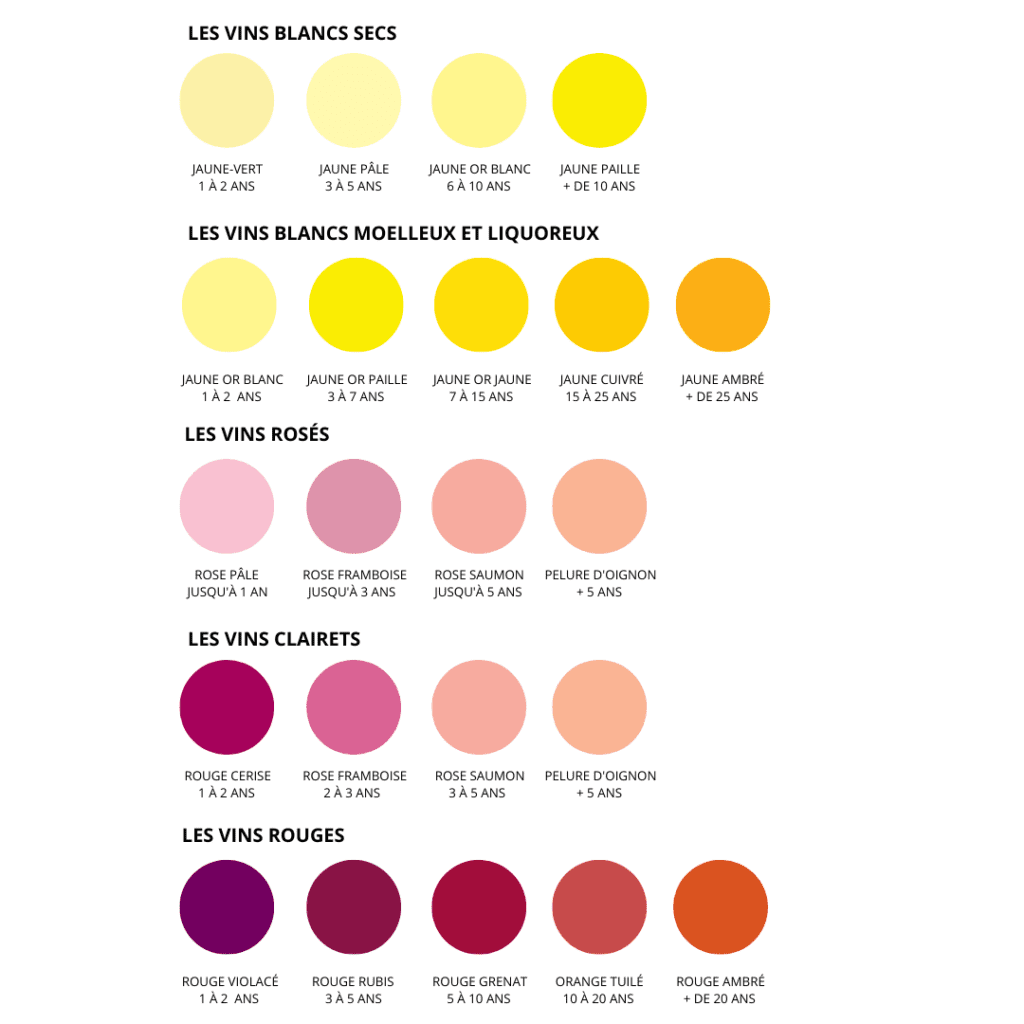
The color of a wine gives an indication of its age. For red wines, the color changes from purple (young wine) to brick/red-brown (older wine). For white wines, it evolves from greenish-yellow (young wine) to orange (older wine).
An orange hue in white wine can also indicate a sweet wine, as sugar content affects its color.
If you notice sediment in a red wine, it means the wine was unfiltered. These deposits are commonly found at the bottom of the bottle or glass. Filtration occurs before bottling and gives the wine clarity, as it can appear cloudy before filtering.
For white wines, white crystals may form if stored in a very cold environment. These are tartaric crystals, a natural element, and are nothing to worry about.
Brilliance
As wine ages, it loses acidity, and therefore brightness. Brightness is observed through the way light reflects on the wine’s surface. If the wine appears dull, it is past its peak. Pro tip: open the bottle earlier next time!
Intensity
The intensity describes how deep the color is. Wine is pale if you can see through it against a white background, otherwise it may be medium or dark. These characteristics depend on the grape variety and the wine’s age.
Wine tasting also involves olfactory analysis
Wine tasting continues with the nose, which reveals the aromas, potential faults, and the wine’s evolution.

At first, the wine is smelled without swirling the glass, which allows the taster to identify the initial aromas.
Next, the wine is aerated by gently swirling it in the glass to release its full aromatic potential.
Intensity
The strength of the aromas is assessed by family, the main ones being Fruity, Vegetal, Woody, Spicy, Empyreumatic, Animal, Balsamic, and Mineral.
Aromas are created through the process of alcoholic fermentation and are influenced by factors such as grape ripeness, the wine’s age, vinification methods, and the grape variety essentially, many different elements.
Aromas evolve as the wine ages. In its youth, wine presents fresh fruit and floral notes. As it matures, it develops aromas of candied fruits, mushrooms, and other complex nuances.
Wine tasting: a gustatory analysis in three steps
While wine tasting is often experienced in a single moment, the gustatory analysis proceeds in three successive phases.
The attack
This is the very first impression the wine makes on the tongue when the taster takes a small sip. It reveals the wine’s temperature, any effervescence, and begins to convey an idea of its gustatory personality.
The mid-palate
Also called the “grumer” phase, this stage corresponds to the wine’s full expression in the mouth. The taster swirls the sip around the mouth for a few seconds, almost “chewing” it, then draws in a small amount of air to help aromatic molecules reach the olfactory bulb via the retronasal pathway.
At this stage, all the flavors, aromas, textures, and structural elements of the wine are perceived. These olfactory, tactile, and thermal sensations combine to give an overall impression. The taster’s task is to differentiate them, analyze each, and judge the balance of the wine.
The finish
This final stage corresponds to the wine’s aromatic persistence, or length on the palate, after swallowing (or spitting). It provides an indication of the wine’s greatness. The longer a wine’s finish, the higher its quality. This persistence is measured in seconds or caudalies (from the Latin cauda, meaning “tail”) and can be described as long, full, or, in the best cases, as a “peacock’s tail.” Conversely, it may be fleeting, brief, or short.
It is important not to confuse aromatic persistence with sensations caused by acidity, alcohol, or tannins, which can create a burning, warming, or astringent feeling and mask the aromas. The simplest approach is to focus on the dominant aroma and follow it after swallowing (or spitting) until it fades. The essential point in this gustatory analysis is to identify the wine’s dominant balance.
Finally, no tasting is complete without a conclusion. A quick synthesis should summarize not only the wine’s quality at this moment in the tasting but also its potential evolution. And of course, it is also the time for the taster to express their own personal preference.
L.O Wine guides you through a wine tasting class
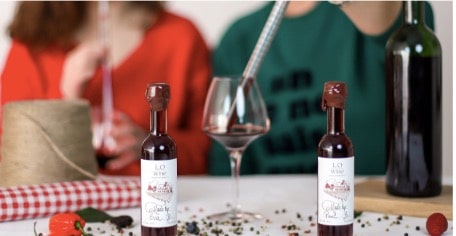
For wine enthusiasts, L.O Wine offers an unforgettable experience at Château Vieux-Mougnac in the heart of Saint-Émilion !
Visit an organic vineyard, learn the art of tasting, take part in a blending workshop, and leave with your own personalized bottle of wine. For more information, visit : https://lowine.fr


