
For several years, scientists have been issuing repeated warnings about global warming, and numerous movements have been launched by a youth increasingly alarmed by the situation.
The projected 2°C rise in temperature by 2050 is already having a noticeable impact on biodiversity and the climate. Naturally, French vineyards are also being affected. In this article, we explore how rising temperatures are influencing vineyards across France.
Consequently, French vineyards are also affected by this change. To this end, we have decided to present in this article the effects of rising temperatures on French vineyards.
French Vineyards: The Impact of Climate Change
Across the country, the 2021 harvest began earlier than in previous years. What explains this precocity? Climate change, which forces winegrowers to continually adapt a trend already noted by INRA in 2018.
Depending on the region, the harvest began at different times this year. In Aude, it started about one week early, in the Loire Valley, one month early, in the Bordeaux vineyards, three weeks early, and in Burgundy, four weeks early.
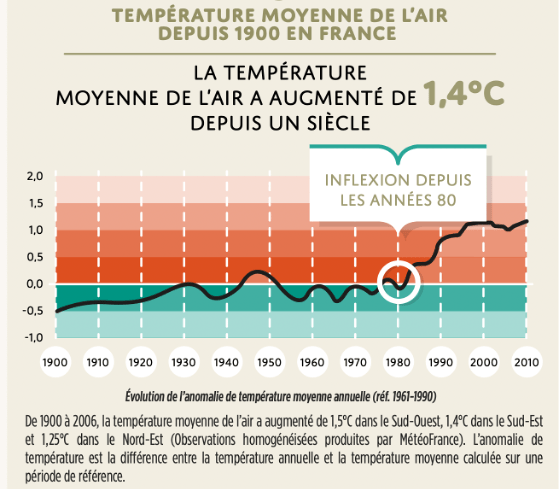
According to Yves Leers, journalist and consultant for “L’Atelier du Climat”, “rising temperatures will have an impact on the vine.” The first effects of climate change are already being felt. As we have seen, harvests are taking place weeks earlier than usual, mainly due to earlier vine flowering.
Furthermore, rising temperatures are already affecting wine production. The alcohol content of some wines has increased by several degrees over recent years. In 2018, it was estimated that wines from the Languedoc could see their alcohol content rise by 1%, as could wines from Bordeaux.
To understand this phenomenon further, we invite you to watch this video produced by Le Monde.
Wine Production: What Are the Risks for the Vine?
As we have seen, the impact of climate change is already being felt in French vineyards.
In the coming years, heat and limited irrigation will be the main sources of concern.
Vines can withstand temperatures of up to 40°C, but water scarcity is becoming a significant problem. Some regions, particularly in the south of France, are already affected by insufficient water supply. During periods of extreme heat, certain vineyard plots do not receive enough irrigation.
This raises questions about water allocation during heatwaves: who will take priority, the winegrowers or other farmers?
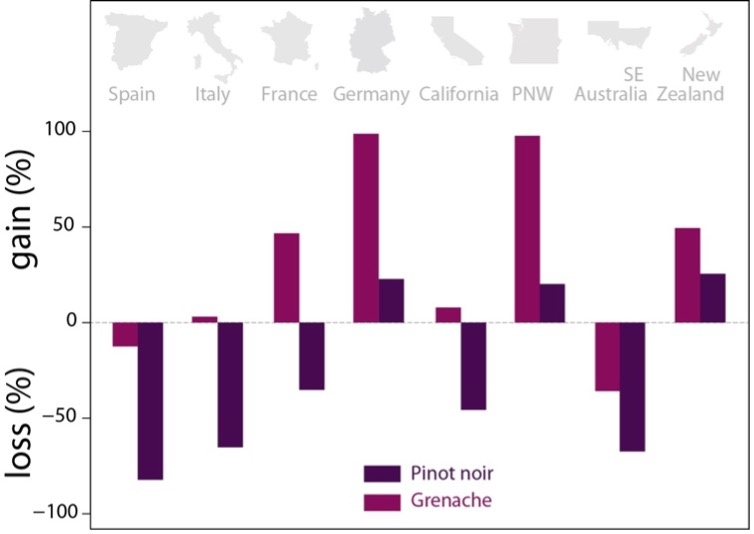
On an international level, climate change is also affecting wine production. Researchers from the French National Institute for Agriculture, Food and Environment (INRAE) conducted a study confirming this trend.
The study indicates that countries with a Mediterranean climate, such as Italy and Spain, will be the hardest hit. They estimate that these countries could lose up to 65% of their vineyards due to rising temperatures and water shortages.
French Vineyards: How to Cope with Rising Temperatures
To face these changes, scientists continue to conduct extensive research.
According to their estimates, wine losses could be limited by making adjustments to grape varieties. In other words, it would be possible to replace more fragile grape varieties with others that are more resistant and tolerant to heat and drought.
These changes could significantly reduce losses in regions still suitable for cultivation. With this approach, losses could drop from 56% to 24% if warming reaches 2°C. If temperatures rise by 4°C, losses could decrease from 85% to 58%.
Another solution proposed by scientists is to select rootstocks that allow for deeper rooting, which improves water uptake. This would help vineyards cope with water scarcity during periods of extreme heat.
There is no doubt that in the coming years, organic, biodynamic, and natural wine producers will need to adapt their production to these natural constraints. For more on this topic, see our article explaining the differences between natural, organic, and biodynamic wines.


